
Whoa!
I started this because I kept losing tiny ETH transaction fees.
At first I shrugged it off as wallet noise.
But then I noticed repeated permission prompts that didn’t make sense, and my gut said somethin’ felt off about that flow.
Initially I thought every extension behaved the same, but then I realized the UX difference mattered a lot and could hide real security tradeoffs.
Really?
Most people assume browser extensions are inherently risky; I did too.
My instinct said you should treat extensions like a house key.
Actually, wait—let me rephrase that: treat them like the key to your safe, not just your front door.
On one hand the convenience is unrivaled, though actually there are hidden layers of privilege and keystore exposure that many users don’t see until something breaks.
Here’s the thing.
I use multiple wallets daily for DeFi and bridging.
I’m biased, but some wallets make routine steps feel safe and clear.
I’ll be honest: bad UI has cost me time and near-miss mistakes, which is maddening.
When you look closely, small design choices cascade into compound risk over months, not just minutes.
Whoa!
Ethereum is simple in theory.
In practice it’s messy because transactions are irreversible.
That means you have to trust both your signing interface and your mental model, and when those two don’t line up you get burned either financially or emotionally.
So my work became trying to align honest UX with technical rigor, and that tension is where tools like Rabby try to sit.
Really?
Security is rarely obvious at first glance.
Permissions dialogs hide intent behind terse jargon.
Sometimes a permission asks for broad access when only narrow access is necessary, and that part bugs me because nuance matters.
The smarter wallets are the ones that show both the surface prompt and the underlying intent, explaining consequences without being condescending.
Hmm…
There are layers to evaluating a wallet.
You watch code audits, but audits alone don’t solve user-facing ambiguity.
On the other hand, open-source code gives community review power, though actually reviewers vary in availability and expertise, so open-source is a strong signal but not a guarantee.
So I weigh code transparency, audit history, and the product’s behavioral nudges when deciding what I trust with real funds.
Whoa!
Rabby wallet landed on my radar because of its intention to improve the extension UX.
I was curious and skeptical at the same time.
Initially it seemed like another competitor trying to be flashy, but deeper use showed thoughtful features aimed at reducing common signing mistakes.
That mix of practicality and polish is what kept me using it alongside my other tools.
Really?
One practical feature I like is account grouping.
It reduces accidental cross-account interactions that I’ve seen ruin trades.
My instinct said that saving a click is convenience, but saving a correct context is security — and Rabby leans into that.
This is subtle but powerful: grouping and labeling accounts makes you less likely to sign something intended for Account A with Account B, which is a real user error vector.
Here’s the thing.
Transaction previews matter more than most designers imagine.
When a wallet shows raw calldata only, non-developers get lost and proceed anyway.
So the best extensions translate calldata into human actions, and they warn when a transaction looks like a token approval that allows a contract to spend unlimited funds, or when a contract interaction could drain liquidity pools.
Rabby’s approach to parsing common patterns into plain-language warnings reduces those collapse moments where you realize too late what you signed.
Whoa!
But no tool is perfect.
Sometimes Rabby surfaces too many warnings and users click through out of fatigue.
That paradox frustrates me because education and friction must be balanced; too much friction spoils usability, too little kills safety.
Designing that sweet spot requires repeated user testing and real-world failure analysis, which is often overlooked in many extension builds.
Really?
I once almost approved a gas-free token scam because it looked like a normal swap.
That incident shaped how I now inspect approvals and contract addresses.
My brain now trains to pause at certain cues, a habit that took months to form.
On the flip side, wallets that help form those cues through consistent UI get my trust faster than those that rely only on user vigilance.
Here’s the thing.
Rabby wallet focuses on behavioral guardrails alongside technical features.
For example, it surfaces token allowance limits and gives quick tools to revoke approvals.
This reduces the need to dig into blockchain explorers every time, and it lowers the cognitive load for casual DeFi users.
If you care about practical security day-to-day, those are the kind of refinements that matter more than marketing buzz.
Whoa!
Performance and reliability are underrated.
Extensions that lag or misreport nonce and gas estimates create nasty UX cascades.
I’ve seen transactions fail because the extension sent stale nonces, and rebuilding trust after that is hard.
So I test wallets over weeks, not just a single session, because intermittent failures tell you more than polished demo videos.
Really?
Browser isolation matters too.
I keep sensitive accounts on separate browsers and profiles.
That might sound overkill, and maybe it is for low-stakes play, but when you handle long-term assets separation reduces blast radius when something goes wrong.
Rabby supports multiple browsers and profiles smoothly, which made my life simpler when I adopted that habit.
Hmm…
There are tradeoffs in features like built-in swaps.
On one hand they are convenient and save time.
On the other hand they centralize routing and may expose you to slippage and sandwich attacks if not well implemented.
So I use built-in swaps for quick checks and external DEX aggregators for sizable moves, which is a habit that safer DeFi users might adopt as well.
Whoa!
Privacy is another angle many underestimate.
Extensions can leak metadata like active sites and transaction timing.
If you’re doing anything somewhat sensitive, consider the signals extensions give off, because those signals can be correlated across dApps.
Good wallets minimize unnecessary network calls and clearly document what they share and why, which is a transparency practice I prefer.
Really?
Recovery options are critical.
Seed phrases are a single point of failure for many.
I keep hardware-backed seeds for long-term funds and use hot wallets for active management, which splits risk appropriately.
Rabby integrates fairly well with hardware keys, which I appreciate because it lets you bridge convenience and cold security without juggling too many tools.
Here’s the thing.
If you want to try Rabby, start small and be empirical.
Install and test with a single memecoin or testnet faucet.
Watch how it displays approvals, and how it prompts for signatures; practice revoking allowances and checking the transaction preview.
If it fits your mental model, you can scale up usage—if not, you’ve learned something without losing real value.
Where to start and how to evaluate
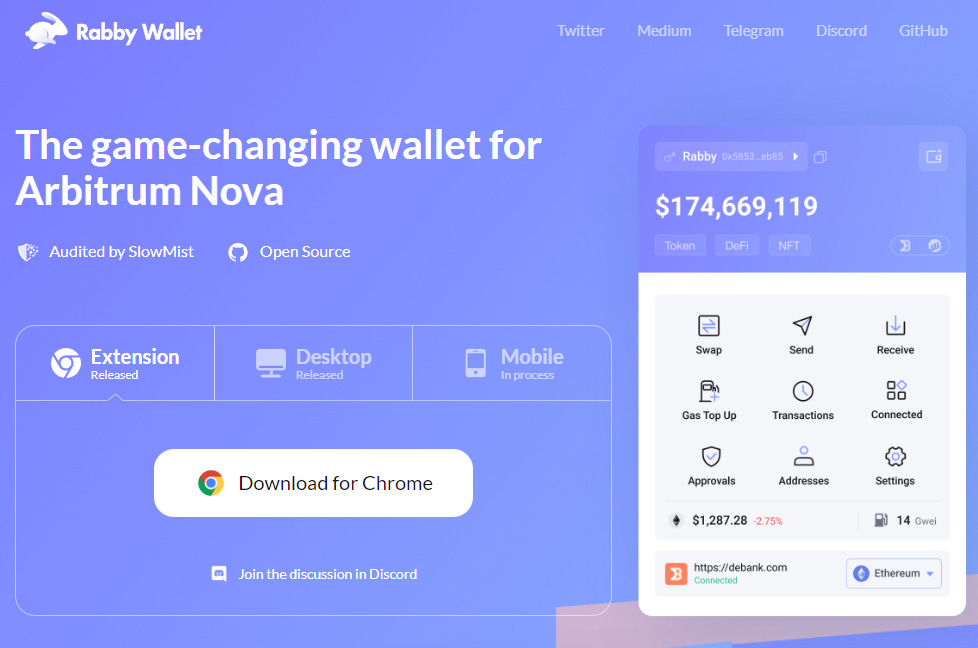
Check this out—if you want a place to download and test the extension, the official page to get the wallet is rabby wallet.
Start on a secondary browser profile and fund an account with a tiny amount of ETH for testing.
Pay attention to how the wallet describes approvals and whether it flags unlimited allowances by default.
Practice revoking an approval and connecting to a simple dApp; see whether the wallet highlights the exact contract address and scope, because that visibility is gold when assessing trustworthiness.
Whoa!
Keep a checklist when testing any extension.
Does it match its claims on privacy and permissions?
Are critical features like hardware wallet integration smooth or clunky?
Also, are updates regular and changelogs transparent, because abandoned projects become risks rather than tools.
Finally, if something asks for broad permissions, dig deeper and ask in community channels before approving.
Really?
Security is social as much as technical.
Being part of a community gives you early warning signs and shared heuristics.
Engage in forums, but be skeptical of loud voices and hype.
Over time you’ll build your own heuristics for what feels trustworthy and what doesn’t, which is more valuable than any single article.
FAQ
Is Rabby wallet safe for daily DeFi use?
Short answer: cautiously yes.
Use it for routine interactions once you’ve tested it on small amounts.
Combine it with hardware wallets for long-term holdings, and keep an eye on approvals and contract addresses to limit exposure.
Can I recover my wallet if I lose my device?
Yes, recovery depends on your seed phrase or hardware key backups.
Write down seeds securely, use offline storage, and consider multi-location backups—cold storage in a safe, encrypted backups, and maybe a trusted custodian for really large sums.
I’m not 100% sure of your personal threat model, but most users are safest with layered backups and hardware-backed recovery flows.